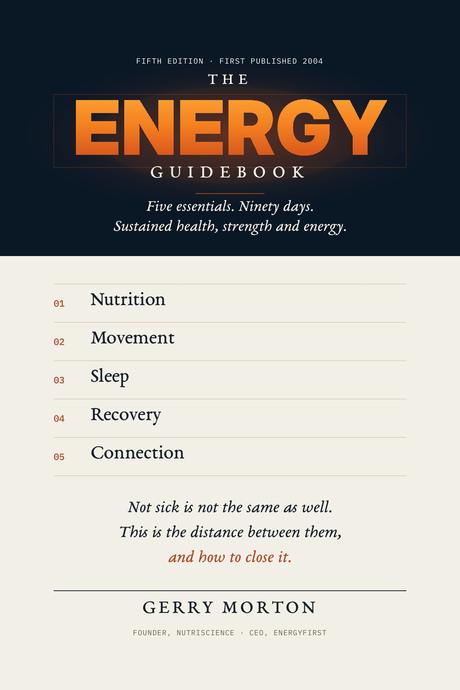
Five Essentials. Ninety Days. Sustained Health, Strength and Energy
The Energy Guidebook is Gerry Morton’s manual on building sustained health, strength and energy, and then holding on to it. Five essentials, the reasoning behind each, and a ninety day plan for putting them in place one at a time.
AuthorGerry Morton, MS Nutrition
EditionFifth, revised and expanded
FormatsKindle ($9.99), paperback ($19.95) and hardcover ($34.95)
Length282 pages
AvailabilityAvailable now from Amazon
What is in it
The five essentials
Nutrition, movement, sleep, recovery and connection, taken one at a time with the reasoning laid out rather than asserted.
Ninety days
A plan that adds one essential at a time, in the order that makes each one easier than the last. It is not a diet and it is not a cleanse.
Written from practice
Gerry holds a master’s in nutrition, has finished four Ironman triathlons and more than fifty marathons, and has run EnergyFirst since 2004. The book is the approach he uses himself.
Every claim cited
The substantive claims carry citations, so you can check the work rather than take his word for it.
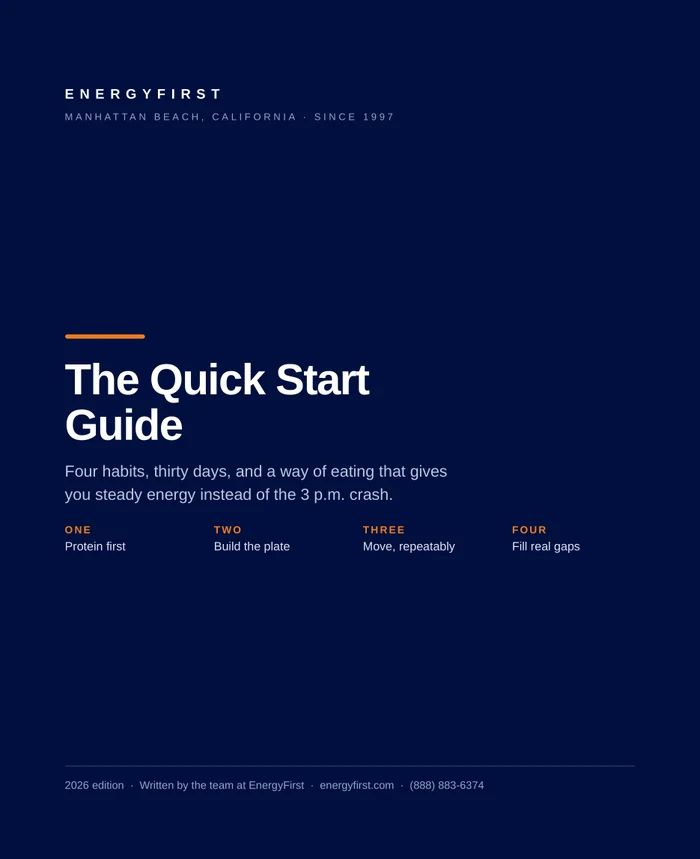
If you would rather try the approach before buying the book, the EnergyFirst Program is the same method in seven free steps, and the Quick Start Guide is a free eighteen-page PDF.
The five essentials
01
Nutrition
Protein first, whole foods most of the time, and a way of judging portions with your hands instead of a scale. The chapter on protein sets a target and shows the arithmetic behind it rather than asserting a number.
Part Three
02
Movement
Strength training is the spine of it. Train each muscle group twice a week, around ten hard sets, with four as the floor. The book is specific about what counts as a hard set, because that is where most programs quietly fail.
Part Four
03
Sleep
A fixed wake time comes first, before anything else in the ninety days, because it is the single change that makes the rest possible. The chapter covers what actually moves sleep quality and what only appears to.
Part Five
04
Recovery
Recovery here means coming down from stress, the daily work of it, not just rest days between workouts. Five minutes of cyclic sighing is the practice the plan introduces. Training recovery is a subset, covered separately.
Part Six
05
Connection
The one most health books leave out, and the one with the largest body of evidence behind it. A review of 148 studies covering 308,849 people found a substantial difference in survival between people with strong social ties and people without. The chapter argues for weekly contact over monthly, and is specific about why.
Part Seven
The ninety days
The plan adds one essential at a time, in an order chosen so each one makes the next easier.
Before day oneMeasure your waist midway between your lowest rib and hip bone, take two photographs, set your protein target (bodyweight in pounds times 0.85), start a six-line daily journal and a three-question loneliness check, book a short blood panel, and start weighing yourself each morning.
Weeks 1 to 2Three anchors: a fixed wake time, weekends included; a step floor of 7,000 a day (6,000 over sixty); and 30 g of protein at your first meal.
Weeks 3 to 4Build to your full protein target, with two to three fists of vegetables at both main meals.
Weeks 5 to 6Strength training twice a week, 30 to 45 minutes, full body, on non-consecutive days.
Weeks 7 to 8Three easy aerobic sessions a week, about 100 minutes in total.
Weeks 9 to 10Sleep: at least 7.5 hours in bed, outside within two hours of waking, and last caffeine eight hours before bed.
Week 11One recurring commitment with other people, and five minutes of slow breathing a day.
Week 12Re-measure and compare with day one, then refine.
Blood work is drawn at the start and deliberately not repeated at ninety days, and the book explains why.
The final chapter puts the whole program on a single page. That page is repeated as the first worksheet in the appendix so you can work from it without holding the book open.
What is inside
Eleven parts, forty chapters, 282 pages.
Part
What it covers
One
Why This Works When Diets Don’t
Two
Know Your Starting Point
Three
Nutrition (Essential 1)
Four
Movement (Essential 2)
Five
Sleep (Essential 3)
Six
Recovery (Essential 4)
Seven
Connection (Essential 5)
Eight
Supplements, the Last Five Percent
Nine
The Method of Listening to Your Body
Ten
Special Situations: women, after fifty, men, and GLP-1 medications
Eleven
Putting It Together: the ninety days, meal plans and recipes
Plus worksheets, a full reference list by part, and an index.
Whether it applies to you
Part Ten exists because the same five essentials land differently depending on who is following them. It covers:
Women, including what changes through perimenopause and after
After fifty, where the protein and strength targets move rather than relax
Men
People taking GLP-1 medications, where muscle loss is the specific risk the chapter addresses
If you are in one of those groups, that part is written for you rather than appended as an afterthought.
How the evidence is handled
Every substantive claim carries a citation. There are more than 500 of them, to 428 sources, listed by part, so you can check the work rather than take anyone’s word for it.
Before anything was called essential it had to pass four tests, stated in Chapter 3 and then applied in public:
Magnitude. Is the difference between getting it right and getting it wrong large?
Non-substitutability. Can something else do the job instead?
Modifiability. Can you actually change it?
Universality. Does it hold for most people, most of the time?
Supplements are covered too, in a part called the last five percent, which is the book’s estimate of how much they matter. The author’s companies sell supplements, and the book says so.
You also get a ninety-day plan, meal plans and recipes, and worksheets, including the whole program on a single page.
About Gerry Morton
Gerry Morton holds a master’s degree in nutrition and has run EnergyFirst since 2004. He has finished four Ironman triathlons and more than fifty marathons, and he chairs two TIGER 21 Groups in Los Angeles.
He does not write as a spectator. Every practice in the book is one he keeps or has tried and dropped, and the chapters say which. In a few places his own habits do not match his own advice, and the book prints that rather than tidying it away.
He also sells supplements, which is worth knowing before reading a book that grades them. The book puts that category at roughly five percent of the result. The conflict is disclosed on page one, and the only place his companies’ products appear by name is a single appendix at the back.
The book is the basis of the talks and workshops he runs for companies and peer groups.
Questions
Is this a diet book?
No. There is no elimination phase, no cleanse and no food list to follow. Nutrition is one of five essentials and it is about protein, whole foods and portions you can judge by hand.
Do I need to buy supplements to follow it?
No. Supplements are one part out of eleven and the book puts them at roughly five percent of the result. Nothing in the ninety day plan requires buying anything.
What formats are there?
Kindle ($9.99), paperback ($19.95) and hardcover ($34.95), all available now and sold by Amazon.
What do I get in this edition?
It is a full rewrite. You get five essentials, a ninety-day plan, meal plans and recipes, worksheets, and more than 500 citations to 428 sources so you can check the work.
Can I return it?
Books bought through Amazon follow Amazon’s returns policy.
These statements have not been evaluated by the Food and Drug Administration. Nothing in this book or on this page is intended to diagnose, treat, cure or prevent any disease, and it is not a substitute for medical advice. Always consult your physician before changing your diet or exercise routine, particularly if you take prescription medication or have a medical condition.
These statements have not been evaluated by the Food and Drug Administration. This product is not intended to diagnose, treat, cure or prevent any disease.